

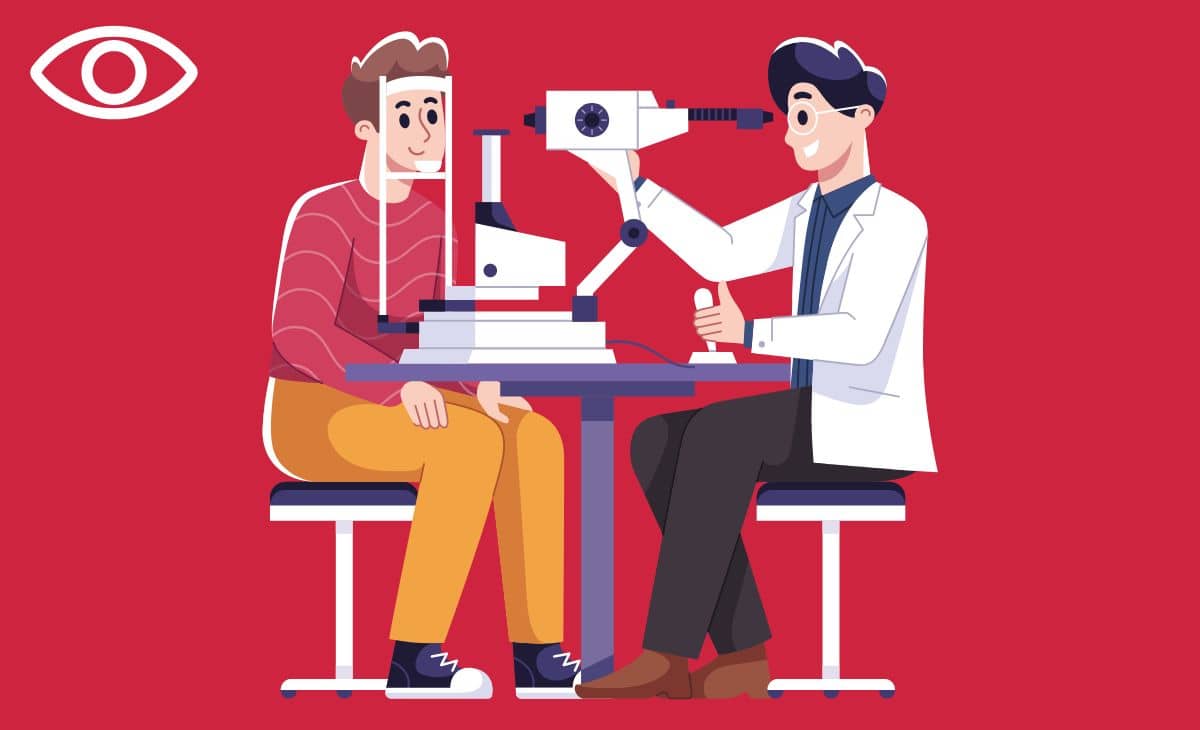
The first time you get a prescription for your eyes, you can not help but think it is wildly different from the ones you get from your healthcare provider when you get a fever. All you can see are numbers littering the piece of paper up and down and strange words from which you are familiar with only two words: left and right. And that too is rarely ever put in in such prescriptions.
There is absolutely no need for you to feel crestfallen about it. There is nothing wrong with not understanding a doctor's prescription. After all, that piece of paper is more helpful to the eyeglass supplier you will need to visit to obtain your glasses. If anything, you simply need to familiarize yourself with a single set of numbers.
What are OD and OS?
When looking at your eyeglass prescription, you will notice these two abbreviations set one under the other on a small table with some numbers placed beside them.
OD stands for oculus dextrus, and OS are the initials for oculus sinister. These are words in the Latin language regarding the right eye and the left eye, respectively.
The part you are to pay attention to is the numbers you will find right beside the two words. These numbers are called diopters (now you may have noticed that these diopters reside under the abbreviations SPH. These letters stand for sphere), and they will have the plus sign or the minus sign before them, and these symbols depend on the manner in which your eyesight is weak.
The numbers, diopters, tell you just how weak your vision is. The closer the number is to zero, the less weak your eyesight is; the further it goes, the worse it is.
You can be farsighted or nearsighted, and sometimes, you can be both altogether, and other times, you can have one eye that is farsighted while the other is nearsighted.
Now, what exactly does it mean to be farsighted and nearsighted? Farsightedness is a condition that might seem simply ridiculous to those who are fortunate enough to have a perfect vision and those of us who are nearsighted. This particular state of weakness in your eyes happens when you find yourself unable to see things that are in your immediate vicinity or are close enough to be perfectly visible. While you can see far ahead, at things such as your classroom whiteboard from the back of the room, and the signs on the road as you are driving past them, you will be unable to read the words in your book if you hold it close to your nose or work on your sewing or even look at your phone unless it is at an arm's length away. Farsightedness is symbolized through the positive sign.
Example of farsightedness: +2.00
When you are nearsighted, the things that are at a distance begin to look blurry. The worse your eyesight is, the shorter distance you can see ahead clearly. Nearsightedness is represented by the minus sign.
Example of nearsightedness: -2.00
Another abbreviation you may find is OU, which stands for oculus uterque, representing both eyes. The diopters beside OU can be negative or positive together, or they can be both at the same time.
Sometimes, you may also discover prescriptions that do not follow the traditional abbreviations and instead use 'RE' to represent the right eye and 'LE' for the left eye.
Now the next bit of understanding an eyeglass prescription is much more complicated than just knowing how bad your eyesight is. Your eyewear prescriber will jot down more than just that in your prescription, and these are more for the convenience of other specialists in this field than it is for your understanding because sometimes, you get referred to different medical experts, and it is much easier for them to extract basic yet essential information about your vision from your prescription rather than having to repeat those mandatory tests all over again.
Fun Fact: Your eyes (irises) are far more unique than your fingerprint, with over two hundred unique characteristics.
What is CYL?
You will notice another column under the abbreviation CYL and maybe another set of numbers underneath it. CYL stands for cylinder — and the numbers underneath it are present only if you have astigmatism and if your healthcare provider believes it needs to be corrected. The numbers provided in this column are the powers of the lens you will require for the correction.
Fun Fact: The color brown is the most common eye color in the world.
What is Axis?
The next column you will see comes under the label of axis. This column will be filled with numbers only if the column under CYL occurs only if your doctor has discovered astigmatism that needs to be fixed. The numbers in this column are always between 1 to 180 and measured in degrees. It reveals the location of any existing astigmatism on your cornea.
What Is Add?
Sometimes, and usually, this condition occurs mostly amongst the elderly. People can have a type of weak vision where they are both nearsighted and farsighted. This means that they require glasses with lenses that can correct their farsightedness and nearsightedness at the same time. This specific type of vision problem is fixed with spectacles that have multifocal lenses. Add is used to provide additional information about the power of the lower part of the lenses.
Fun Fact: Your eyes are insanely complex, and their complexity is second only to that of the brain!
What Is Prism?
This term is rarely seen on prescriptions. It is added only when your healthcare provider believes that you are in requirement of an eye alignment treatment. This means that for you to see properly, your eyes need to look in the same direction at all times, except that yours are misaligned. Most people can get this fixed with treatments that are not invasive — like using glasses that have a prism lens for whichever eye requires it.
Fun Fact: Some symptoms of astigmatism are surprisingly easy to overlook.
Recommendations
Sometimes, your doctor may scribble some recommendations that he or she deems appropriate for you to follow for the improvement and smoother functioning of your eyes. However, these suggestions are not mandatory to heed and may be disadvantageous to your wallet.
Below are some commonly given advice by eye specialists:
- The recommendation of progressive lenses is repeated amongst those who require multifocal lenses to see both far and near. You will have noticed older generations carrying more than one pair of glasses. One for viewing things up close. A pair of reading glasses and another for viewing objects at a distance, single vision glasses. Progressive lenses eliminate the need to carry around more than one pair of glasses and clearly see everything far, near, and in-between.
- Photochromic lenses: you may have noticed some people around you wearing eyeglasses that turn dark (like shades) as soon as they come out under the sun. These are tinted lenses that help reduce eye damage and eye strain since they block up to a hundred percent of the UV rays from the sun.
- One repeated piece of advice is the use of antiglare coating (also known as anti-reflective and AR coating) on your lenses. This is a procedure that allows more light to enter through your glasses by reducing the number of reflections that appear on the lenses.
Fun Fact: Not only can your skin get sunburned, but your eyes can too. Yikes!
The Expiration Date Of Your Eyeglass Prescription
If you are a newbie to wearing prescription glasses, you might not be aware of this — although that is highly unlikely, one should not overlook exceptions.
Your eyesight typically worsens as you age, and this condition is truer for those who have to rely on a pair of glasses to see clearly. Once your eyes have weakened dramatically, you become prone to a gradual worsening of your vision. It progresses as you get older (generally if your eye problem — usually myopia — occurred at the age of growth and development) and stabilizes once you have ascended into adulthood.
You have to get regular checkups at your doctor's to get reports on any progression and deterioration of vision. A routine checkup can detect changes that you may not have noticed.
This gradual debilitation means it is unpropitious to use the same old prescription to get new glasses any time you have broken your current pair or want to try another style. Not only does this discouraged practice not correct your vision and help you see clearly, but it can also strain your eyes and induce headaches with prolonged use.
Fun Fact: Your eyes do not grow, so they have been the same size since you were born.
The Limit Of Your Eyeglass Prescription
While your eyeglass prescription can inform you and correct you of myopia, hyperopia, and astigmatism and even possibly help you see better when you have cataracts, it can not list out other problems you might have that might not have been medically detected — which is a rare thing to happen but can still come to pass in the presence of negligence.
So, even if you believe your lens powers do not require changing and thus nullify the need to have a regular checkup, you can still have unnoticed issues that can only be properly diagnosed through a medical test by a professional.
As you age, you become more prone to eye diseases that can result in grave visual impairments if left untreated and uncorrected. It becomes crucial to have routine appointments with your healthcare provider to ensure you are in a healthy state overall and to catch anything unsavory trying to develop inside of you before it becomes too big or serious.
Questions That Are Frequently Asked About Eyeglass Prescriptions and Similar Matters
What is the connection of the retina with farsightedness and nearsightedness?
The retina is a layered structure of nerve tissue at the back of your eyes. These layers of nerve tissue are light-sensitive and help you perceive your visual surroundings when light enters your eyes and falls directly upon them. It helps you form an image, helps you see. However, when you become nearsighted, the light entering your eyes falls short of the retina, forming the images in front of your retina rather than directly on it. Similarly, the light entering your eyes when you are dealing with farsightedness fails to aim directly at your retina, and instead, rather than falling short of it, it forms an image behind it. In short, farsightedness and nearsightedness occur when the light from your surroundings fails to directly target your retina as it should.
Fun Fact: No, wearing your grandpa's glasses to see what it feels like to wear glasses does not make your eyes weak, even though you can experience dizziness and disorientation.
Can you get your glasses without a prescription from your healthcare provider?
You can easily obtain non-prescription eyeglasses without a doctor's advice. However, for the purpose of correcting your vision, you will be able to the correct prescription glasses only if you go through an eye care provider — or if you run eye tests at home through legally approved self-testing programs.
Does the type of glasses you choose to wear interfere with your vision, and can it weaken your eyesight even more?
The type of glasses you choose to wear does not interfere with your vision to an alarming degree (usual symptoms of discomfort can last until you get used to your glasses), nor does it weaken your eyesight.
Fun Fact: People who have blue eyes have a rough time under the sun than those with darker eye colors.
Can your eyeglass supplier make do with only your diopters?
Your eyeglass supplier needs more than just your diopters to make you a pair of suitable spectacles. The primary purpose of an eyeglass prescription is to inform your eyewear supplier precisely of the measurements you need to be able to bend light to the exact point on your retina to form an image. Your prescription is measurements of the lenses that you need for a corrected vision.
Fun Fact: As long as they were not born blind, blind people can see their dreams.
What is the difference between an optometrist, an opthalmologist, and an optician?
Below are some basic specifications for each job expert that goes beyond just their varying levels of education:
- Optometrists: these are professionals who run tests, perform exams and give out prescriptions for corrective glasses, lenses, and medications.
- Ophthalmologists: these are medical practitioners who can give you all the services that an optometrist can and more since they can perform surgeries as well as provide medical assistance.
- Opticians: these are eye care providers who cannot perform any of the services mentioned above. They can not run tests, and exams, make a diagnosis or give out prescriptions and medications. However, their job is to fit you with corrective devices — contact lenses, eyeglass lenses, frames, etc.
What are myopia and hyperopia?
Myopia is the scientific term used for nearsightedness while hyperopia is the scientific term for farsightedness.
What is astigmatism?
Astigmatism is a type of disorder where, rather than having one focal point, there are multiple focal points on the retina. In simpler words, the light rays entering your eyes are unable to align themselves and hit a mutual spot on the retina. It occurs when the surface of your eyes, your cornea, has a curve that is out of the normal, which forms blurry images on your retina. If you have astigmatism, you might be seeing things (especially lights) as if they have been stretched out in multiple strands. It is a majorly genetic condition but can occur when there has been an infliction of injury on the eyes or a surgery.
What is the difference between a regular eyeglass prescription and a contact lens prescription? Can we buy contact lenses using our eyeglass prescription?
The difference between the two lies in the distance between the prescribed glasses or lenses and the eyes, and the specific details required for contact lenses.
Between the eyes and prescription glasses is a little distance, which is hard to miss. The distance is over 14 millimeters. The tests you are made to take for an eyeglass prescription are taken according to the distance. On the other hand, your contact lenses rest right on top of your irises, with no gaps between them, visible or not. This decreased distance requires further specifications from the tests run by your eye care provider.
So, no, you will not be able to get yourself contact lenses through your eyeglass prescriptions. Of course, you can always buy non-prescription contact lenses without any prescription at all.
What is the downside of progressive lenses?
Progressive lenses, while being extremely convenient and practical, can prove to be unsuitable for some people. They can become disorientating for some individuals, inducing headaches, dizziness, and distortion — especially to those who find it demanding to overcome and adapt to the sudden change and strain. Progressive lenses can also alter one's peripheral view.
Is it possible for your farsightedness to remain constant throughout your life, especially if you got your first glasses at a young age?
Typically, farsightedness occurs at a young age before gradually worsening as you grow older. Once you enter your twenties and step into adulthood, your vision starts to stabilize, and frequent changes in power decrease.
Fun Fact: Did you know that staring too long at your TV screen does not ruin your eyes, contrary to what you have been told ever since you could remember?
If you do not wear your prescription glasses as you are required to does it lead your eyesight to a worsened state?
If you are worried about not wearing your glasses regularly and facing repercussions like eye damage or drastically weakened sight, you can rest easy with the knowledge that the worst to come is the resurfacing of the symptoms specific to your issue — like headaches, blurry vision or having to strain your eyes or squint when you have myopia.
Can you tell if you are legally blind by your eyeglass prescription?
Yes, your eyeglass prescription can tell you if you are legally blind. Having a power of more than -2.00 implies you are considered legally blind.
Is there any way of naturally getting rid of your eyeglasses and correcting your vision?
There have been no discoveries yet of such techniques for a natural correction of weakened vision. However, there are some exercises that you may find yourself being advised to undertake to relax or exercise your eyes and their muscles. You will also be frequently advised to blink more often and deliberately while working long hours in front of screens.
If you are facing difficulty comprehending the meaning of your eyeglass prescriptions, the best initiative to take is to confer with your eye care provider directly. They can impart you a better understanding of the terms and numbers and how they relate specifically to the problems you are having with your vision and eyes. The explanation given above is just what the terms mean generally, and they do not include any particular relation to you, which might set a limit to your understanding of them.
Having mentioned that, it is also important to display disapproval on the matter of researching medical and health-oriented topics on the internet and not seeking actual professional advice. It is heavily recommended that you consult appropriate healthcare providers regarding diagnosis and prescriptions.
References
Below are the websites referred to for this article:
